
The Binding Brief: An Experimental Ebola Drug, Using AI in Biomedical Research, and Taking Inspiration
No. 02 | May 27, 2026

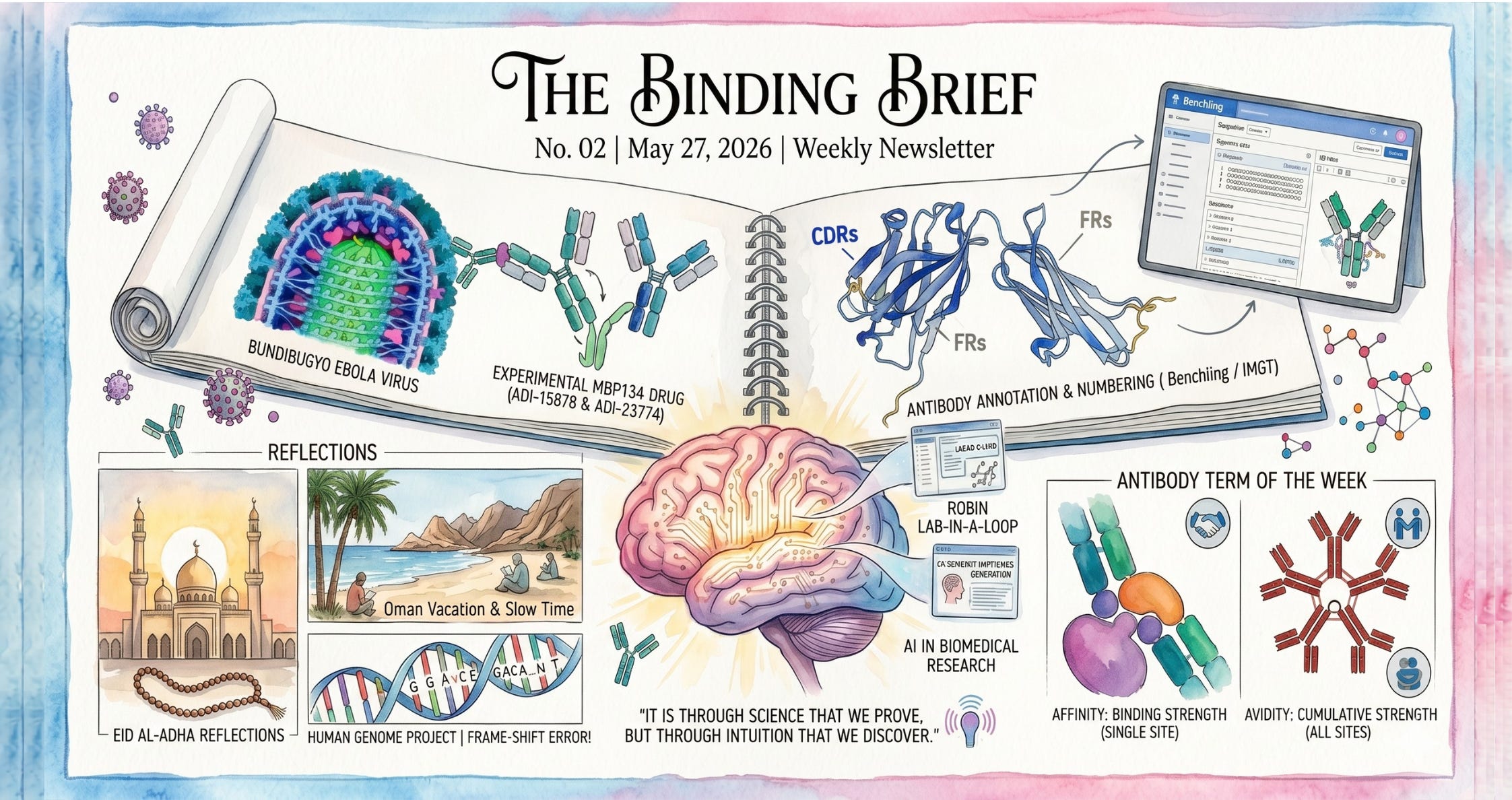
Welcome to the second edition of the ‘The Binding Brief’, a weekly newsletter dropping in your inbox every Wednesday where we shall journey together into the world of antibodies.
This week, we have some exciting things to discuss.
Raw Data: Is it alright to rest and not be productive? 🔗
This Week’s Deep Dive: Plagiarism or taking inspiration? 🔗
Bench Notes: How can you integrate your lab notebook and molecular biology suite into one system? 🔗
Antibody Spotlight: Experimental Ebola drugs - what do we have so far? 🔗
In Silico: How do you feel about using AI in Biomedical Research? 🔗
Antibody Term of the Week: “Do I have affinity or avidity towards you?”, asked an antibody to an antigen. 🔗
1. The Raw Data
If you’re reading this newsletter edition right as it goes live, I am probably at the beach enjoying the ocean waves, the date palm trees, staring at the hard rocky mountains of Oman, while my body makes copious amounts of Vitamin D in the 46 ℃ weather. Today is Eid al-Adha, a major festival in the Islamic calendar celebrating faith, sacrifice, and generosity observed by Muslims around the world. We are off for almost the entire week and decided on a last minute staycation at a beach resort. As I grow older (although I still feel like a kid sometimes), I have started to appreciate staycations — quiet quality time with the family, a stroll at sunrise and sunset, no digital devices, and reading a book before bed. The hustle culture has made such slow periods of time seem unproductive. But, each time I go on vacation, I come back feeling more energized and most importantly, focused and enthused. So, may be next week’s “Raw Data” section might have something more profound for you all after an intense 2-day period filled with reflections. Haha. Just kidding. I hope I don’t pass out from the heat.
Wishing all my readers a very happy Eid al-Adha from Oman.
May this occasion bring peace and love to all of humanity.

2. This Week’s Deep Dive
I had an interesting experience this week. I was scrolling through LinkedIn (hello job search!), and I noticed that a page had written an article. My eyes of course popped open when I saw ‘antibodies’. As I read through the post, it felt eerily similar to the one I had written on Substack few weeks back on the naming convention of monoclonal antibodies. I was little suspicious at first — being an informative article, it is possible that someone wrote it all by themselves. Some of the wordings sounded the way I would write something. A little verbose to add some extra clarity… is my style (working on the art of brevity). But when I looked at the image, I was sure they had plagiarized taken inspiration from my article. Although I had used Google Gemini to create the main infographic, I had also used Canva subsequently to make edits to the image. And lo and behold, the same edits were also present on the image on the article, just with some color modifications.
I thought a lot about whether I should reach out to the page owner and mention how similar it is. My mind had 100 thoughts of course! What if they deny any plagiarism? What if they think I am being petty? What if they just block me and move on with their lives? I guess this article felt very personal because I had put in a lot of time, effort, and thought while writing it. I reached out with a kind message. Within minutes, the editor responded that they were unaware and it was an oversight on their part. They immediately credited me for it and added a link to my Substack article.
Not that that credit brought any extra views or subscribers to my Substack; that is beside the point. But, this small incident taught me something that I struggle with many times - if something is yours, own up to it, small or big. Ask for what is yours, for it could be a genuine oversight.
If you haven’t read this article yet (it’s also my most viewed article!), head over and check out how antibodies are named.
3. Bench Notes
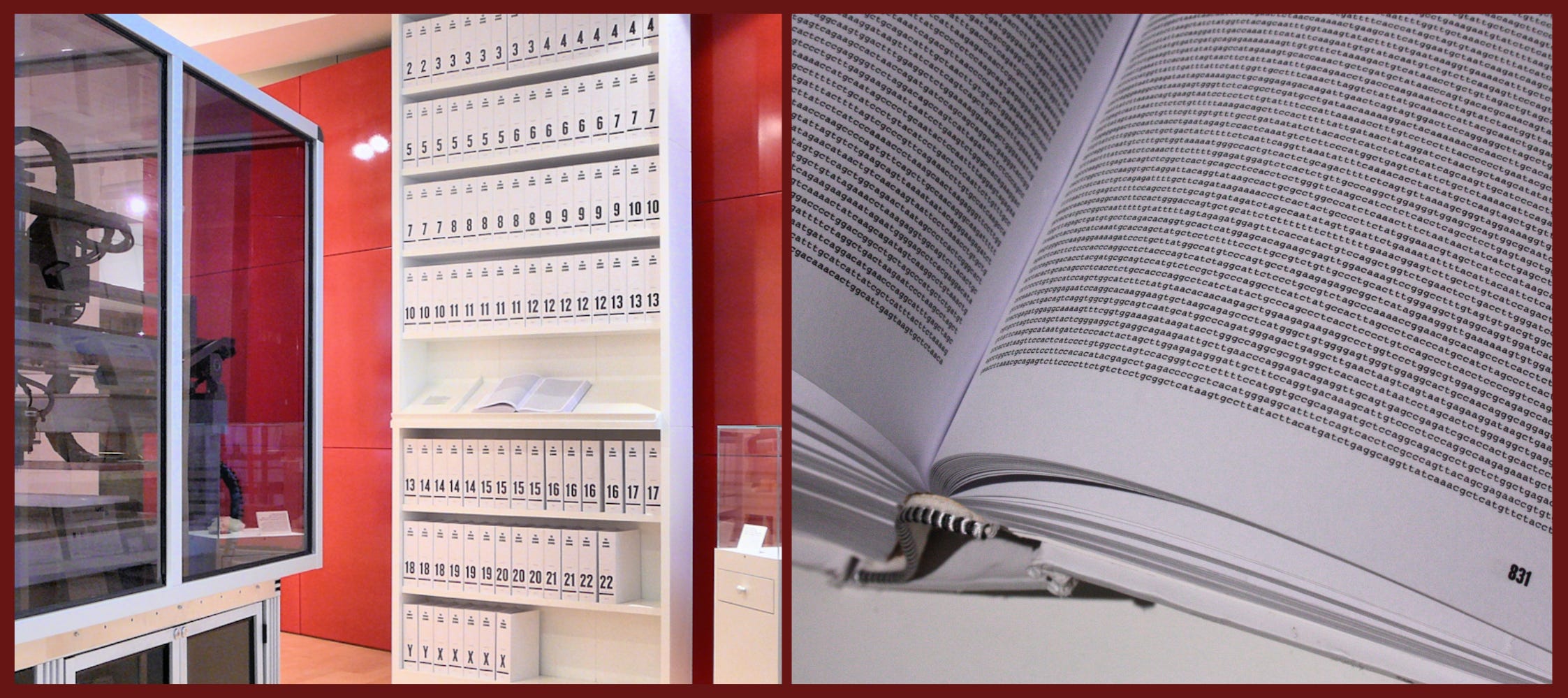
Enough reflections for today. Getting back to science now. On June 26, 2000, when the Human Genome Project had a “rough draft” ready, it was announced as a cool press release. Rough draft? But in this case, a rough draft meant volumes of books that contained a strings of As, Gs, Ts, and Cs catalogued by the human chromosome number. If you skipped a single letter ‘A’, it would create a frameshift error1 on the entire human genome. Imagine the catastrophe!
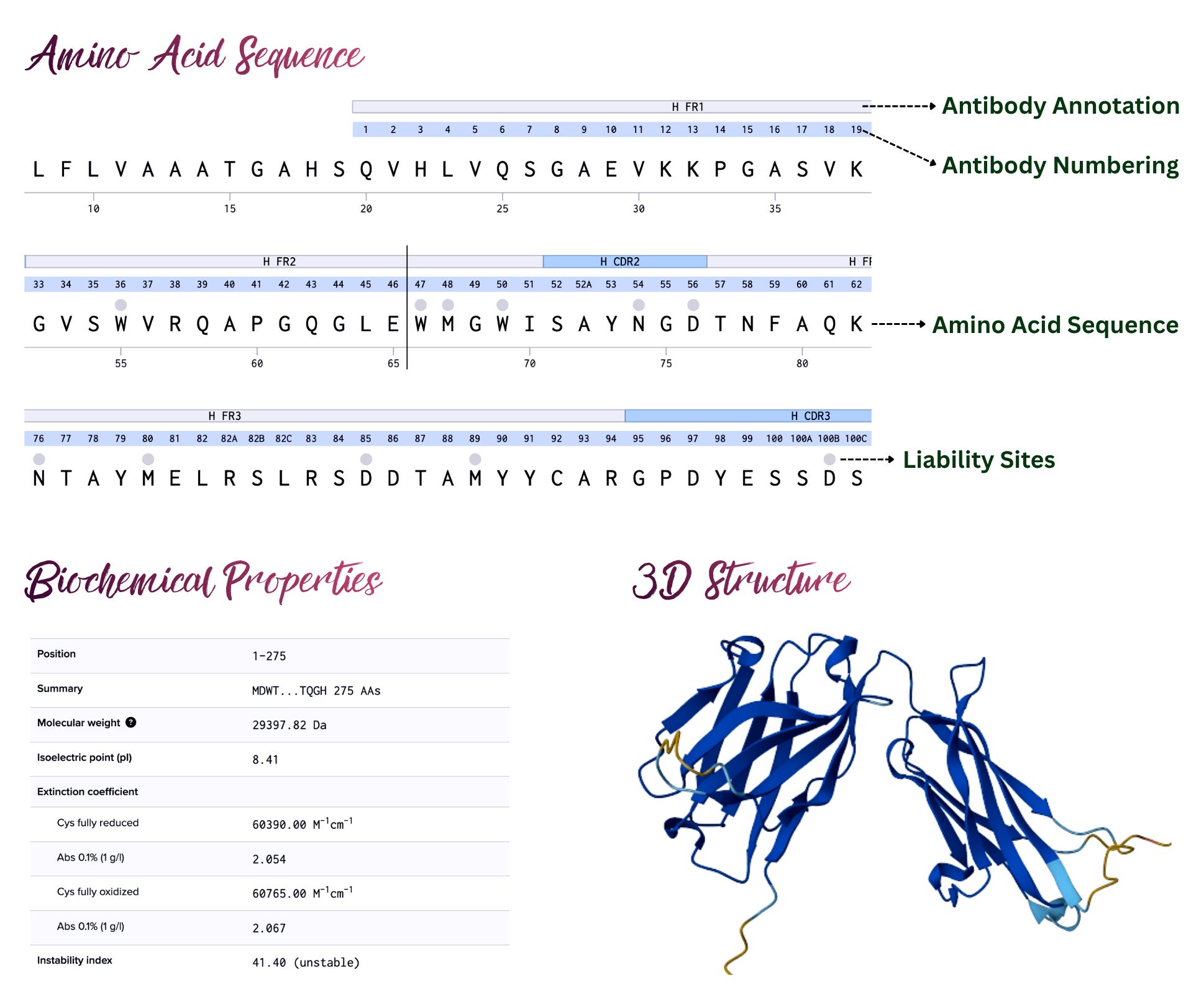
But today, we need not write down every single letter of the DNA sequence. We have a whole suite of modern molecular biology tools. The one I use (and I’d highly recommend) is Benchling. Of course, it provides a lot of basic tools to go with your cloning needs. But, more specifically, for those working with antibodies in the lab, it has several features such as:
Antibody Annotation: delineating the variable complementarity-determining regions (CDRs) and conserved framework regions (FRs) of the antibody.
Antibody Numbering: based on either the Chothia, Kabat, or IMGT numbering scheme (more details on that in an upcoming article).
Chemical Liability Sites: where in the sequence are antibodies sensitive to degradation caused by either asparagine deamidation, tryptophan oxidation, methionine oxidation, and aspartate isomerisation.
An added advantage of Benchling is that also has an Electronic Lab Notebook functionality. A good way to have it all in one place and cross-link sequences to lab notes! Make sure to sign up on Benchling using your academic email ID for many extra perks.
PS: This is not a sponsored post. If I love a new software or a new coffee shop, I can’t help but share it with all.
4. Antibody Spotlight
Last week on The Binding Brief, we touched upon the low therapeutic efficacy of Inmazeb and Ebanga (the two FDA-approved monoclonal antibodies against the Zaire Ebolavirus; EBOV), for the Bundibugyo virus (BDBV), the Ebola strain currently ravaging through the Democratic Republic of the Congo and Uganda, underscoring the need for broad spectrum antibodies. Dr. Annicka Evans, PhD addressed the Ebola vaccine gap on the previous edition of The Biotech Tea. With no approved monoclonal antibody-based therapies or vaccines ready for deployment for BDBV specifically, given the urgency, the next best option is the use of experimental therapies.2
One such experimental drug being considered is MBP134 developed by Mapp Biopharmaceutical, a San Diego-based Biotech company, in collaboration with the US Government’s Biomedical Advanced Research and Development Authority (BARDA). MBP134 is a pan-ebolavirus two-antibody cocktail comprising antibodies ADI-15878 and ADI-23774. A single 25 mg/kg dose showed sufficient protection in ferrets and non-human primates against the Zaire, Sudan, and Bundibugyo ebolavirus. MBP134 was administered in the 2022 outbreak in Uganda that primarily involved the Sudan virus. Being an investigational therapeutic drug, it was administered under ‘compassionate use’ in consenting patients. There is a lot of talk currently that MBP134 and Remdesivir (an antiviral) are the experimental forerunner drugs for a clinical trial being sponsored by the WHO with the approval of the local governments. This is the news I will be following in the coming days!

5. In Silico
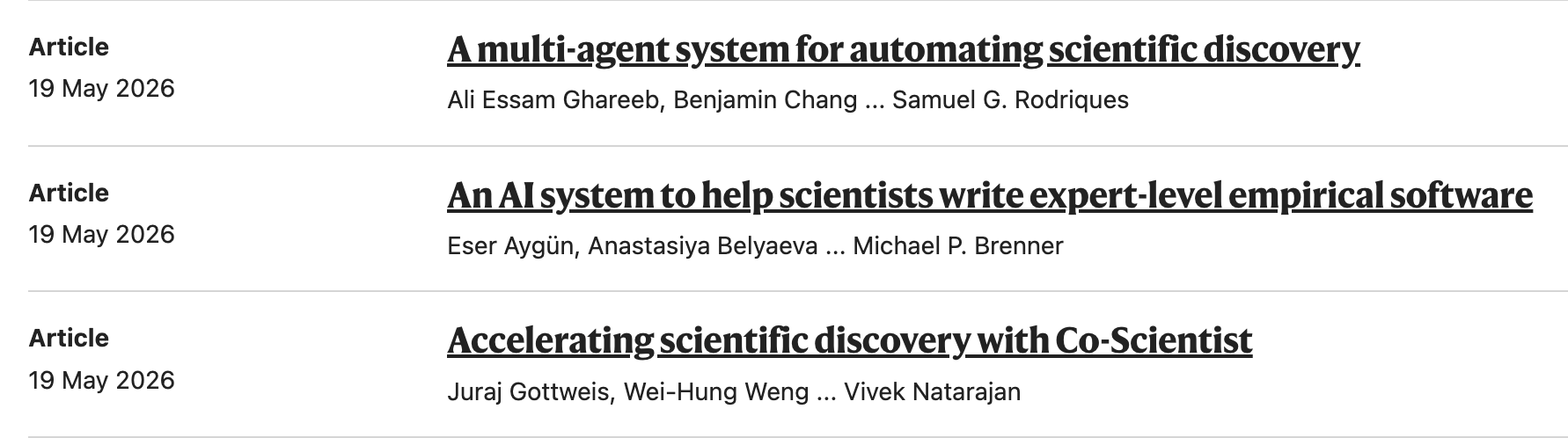
The buzz in the AI x Bio world this week was that Nature published 3 articles on the same day! FutureHouse introduced Robin, a multi-agent system to provide an iterative lab-in-a-loop framework that can conduct hypothesis generation, experimental design, results interpretation, and updated hypotheses. Google DeepMind introduced Empirical Research Assistance (ERA) to help scientists write expert-level softwares, solving the bottlenecks in computational experiments. In other big news, Google DeepMind also introduced Co-Scientist, similar to Robin, to assist in hypothesis generation and provide structured thinking support.
I know I am most excited to try out Co-Scientist. I will revert back when I get to try these out and apply it to solve a tangible problem. But, before that, I know there has been a lot of reticence about using AI for Biomedical Research. And that’s how It should be! As scientists, it’s our job to question everything. We have to query everything, test it, validate it, and most importantly, know the constraints of any tool or system. Speaking on the bio world, the narrative that AI is coming for our jobs seems like a little bit of a hype. No AI system can be built to do media changes over the weekend on our behalf (IYKYK). I don’t think anyone will lose their jobs to AI, but they might lose their jobs to someone who knows how to use AI effectively.
At the end of the day, we as humans have something that AI can’t take away from us and that is the power of intuition! Every scientist has felt this power in their career when logic did not make sense to piece together the reasoning to do an experiment or test a hypothesis, and our lab mates thought we were psychos. But we still went down that path because something in us told us that there was value in exploring and may be, it might provide new insights and answers. In this AI world, a superpower would be to hone this skill of intuition while you use AI to compress drug discovery timelines.
“It is through science that we prove, but through intuition that we discover.”
- Henri Poincaré (French Mathematician and Theoretical Physicist)
6. Antibody Term of the Week
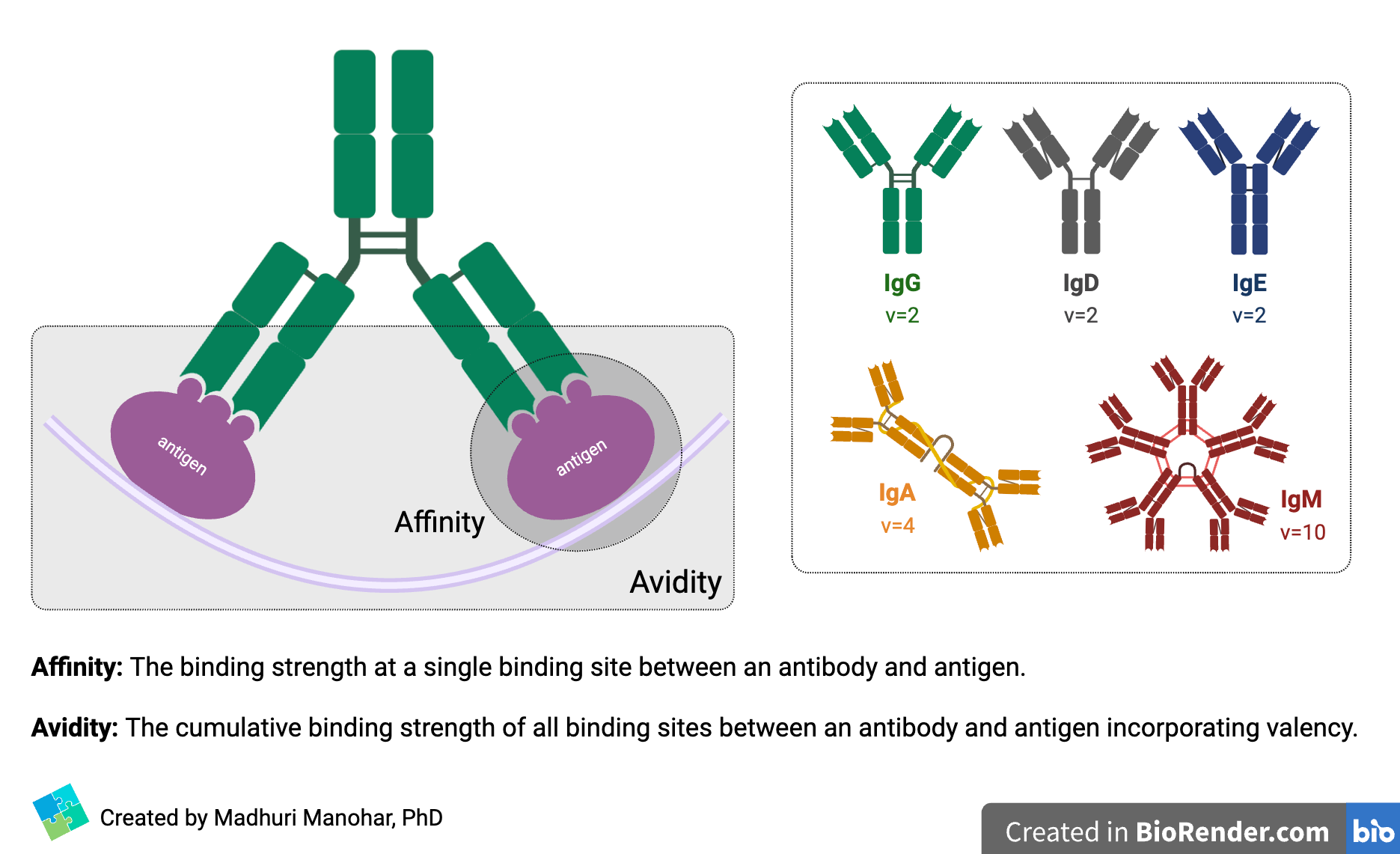
Today we shall learn the difference between the terms affinity and avidity. Affinity refers to the binding strength between an antibody and antigen at a single binding site. Whereas, avidity refers to the cumulative binding strength between an antibody and antigen taking into account all the binding sites and valency. An easy way to remember it - think of the strength of the bond formed when you give someone a handshake (affinity) versus when you hug them with both hands (avidity).
I hope you all enjoyed this edition of ‘The Binding Brief’. If you have suggestions for topics you’d like to know more about… ⤵️
This site is free and I intend to keep it that way for as long as I can because good science communication should be accessible, especially for students. If you enjoy what you read and feel like buying me a coffee along the way, I won't say no. ☕ And if you're not a student, consider paying it forward to one who is.
Frameshift Error: DNA sequences are read in bits of 3 alphabets, also called nucleotides (A, G, T, C). Each bit of 3 corresponds to a codon, which dictates the amino acid, the basic unit of a protein. If you skipped a single letter, it would shift all the nucleotides up front, changing the combination of these 3 alphabets. If you had ATG GCA, it would denote Methionine-Alanine. But if you skipped the ‘T’, it would read as AGG CA, which would denote Arginine-some other Amino Acid. Imagine the catastrophe this frameshift error would cause when someone was typing the sequences of the human genome containing 23 chromosomes!
Experimental Therapies: Treatment options that have shown promise in research but have not yet completed all phases of clinical trials to establish safety and efficacy for final regulatory approval.
Following along with these briefs is becoming a weekly habit. The curation of practical laboratory knowledge alongside current research developments is a format more science newsletters should adopt. Thank you for such a great read.
Thank you for introducing me to a new word avidity.