
The Binding Brief: Fabricated Western Blots, CamSol Solubility Tool, and Protein Concentrations
No. 03 | June 3, 2026

Welcome to the third edition of the ‘The Binding Brief’, a weekly newsletter dropping in your inbox every Wednesday where we shall journey together into the world of antibodies.
This week, we have some exciting things to discuss.
Raw Data: Science is for everyone
This Week’s Deep Dive: Communication is key in science - 10 tips!
Bench Notes: Are you getting accurate protein concentrations?
Antibody Spotlight: p53 Antibodies by Thermo Fisher Scientific
In Silico: Using CamSol to study the protein solubility score
Antibody Term of the Week: Epitope versus Paratope
1. The Raw Data
As always, I love this section of the newsletter, where I share my raw, unfiltered thoughts. I had a chance to chat with Edgar Huitema, PhD (The SuperAdvisor) yesterday, and one thing we touched upon is lab environment. We all love a happy lab!
Yes, the supervisor plays a central role in keeping the lab a happy and collegiate space. But, each one of us has a part to play too. One of the subtler things that contributes to a joyful lab culture is being genuinely happy for another person’s success. We all know how hard it is to get good data. It involves a lot of sweat and tears, and every result that adds to the body of scientific knowledge is hard-won.
Yet there’s often a small tinge of jealousy when we’ve been struggling for months and someone else gets that pretty bar graph with tiny error bars. But someone’s success doesn’t take away anything from us. It doesn’t block our path or reduce our chances. If anything, it expands what’s possible. This isn’t competition because there is space for everyone in science.

2. This Week’s Deep Dive
Being a researcher demands an extraordinary breadth of skills. You need to think clearly, plan meticulously, design sound experiments, execute diverse protocols, apply statistics to make sense of your data, situate your findings within existing literature, navigate the push and pull between your own instincts and your supervisor's expectations, and constantly upskill, often learning new techniques on the fly. This is what makes finishing a PhD feel unlike anything else: you develop all of this within a compressed three to four years, even if it begins with the unsettling sensation of being thrown into the deep end.
And yet, in spite of doing alllllll this, none of it lands if you can’t communicate it.
The first real opportunity most researchers get to convey their science is in routine lab meetings. A relatively low-stakes space to grow your scientific voice and develop your communication skills. Depending on your lab culture, though, these meetings can feel daunting. To mark my 10th article on Substack, I’ve put together 10 tips to help you navigate these dreaded meetings. I hope you find them useful.
3. Bench Notes
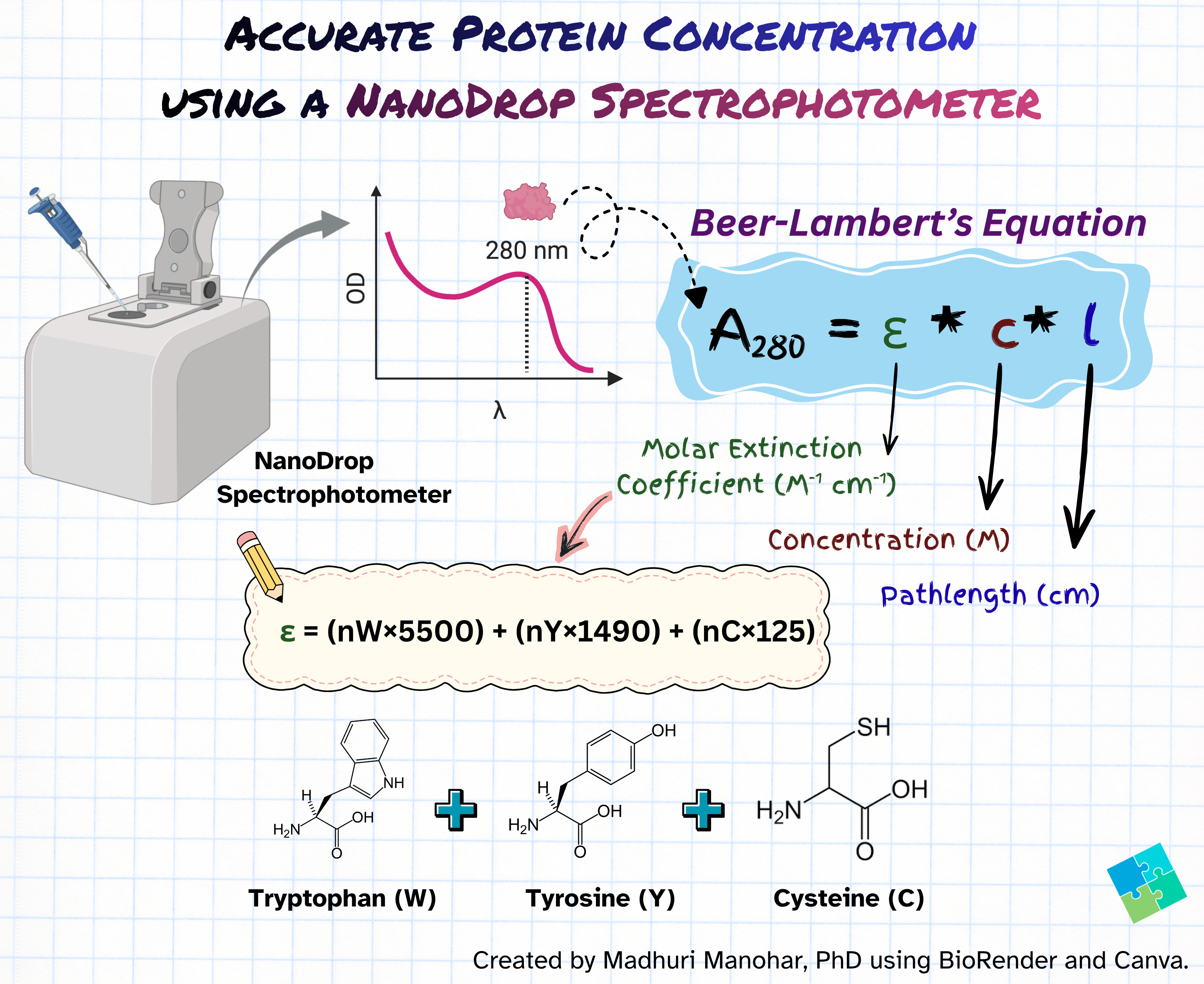
There are many ways to quantify your protein: Bradford, BCA, A280 absorbance, Qubit, SDS-PAGE densitometry, mass-spectrometry and more, each based on different principles. Measuring the absorbance at 280 nm was my personal preference, which can be done in a 96-well plate format or on a NanoDrop. Working with 14 antibodies each day, the NanoDrop was my go-to: it was fast and needed only 2 µL of sample.
One thing to watch out: the NanoDrop defaults to 1 Abs = 1 mg/mL, which assumes all proteins have the same amino acid composition. That is rarely the case, if ever, true. UV absorbance at 280 nm is driven by aromatic amino acids (tryptophan, tyrosine, and phenylalanine), and reduced cystines, each of which each absorb differently. Phenylalanine’s contribution is negligible and is typically omitted from calculation. To account for this differential absorbance for a more accurate concentration estimate, input your protein's molar extinction coefficient (ε) and molecular weight (kDa) directly into the NanoDrop software. Both can be calculated using the ExPASy ProtParam tool or Benchling (see Issue #2 of the Binding Brief). The output measurement would give a protein concentration (mg/mL or M) that is different from A-280. Check it out next time you’re in the lab.
Pro Tip: Consistency is key throughout your research project. Use the same protein quantitation technique always.
4. Antibody Spotlight
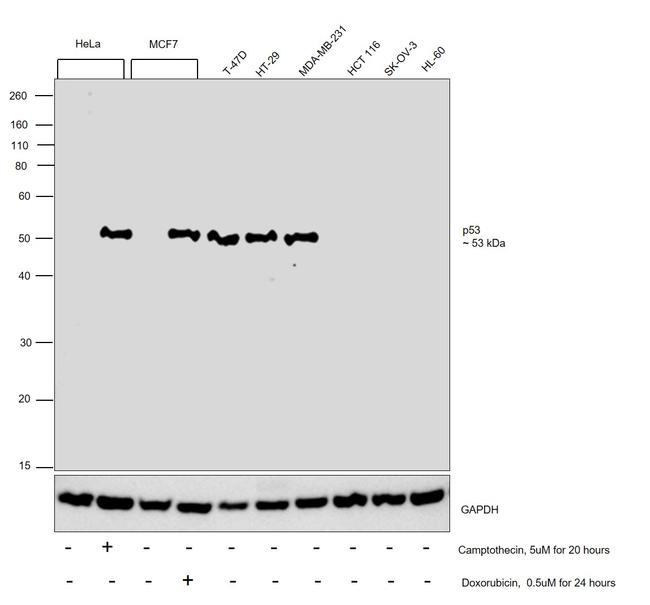
If you’ve been following social media and LinkedIn this past week, there’s been a notable discussion around one of the Anti-p53 monoclonal antibodies sold by Thermo Fisher Scientific. Sholto David, PhD, an analytical scientist in the UK, flagged a potentially fabricated western blot in the internal validation data of a Thermo Fisher p53 antibody. What initially appeared to be an isolated case was subsequently identified as a pattern across multiple p53 antibodies, documented on the blog For Better Science. Johan Duchêne and Reese Richardson have since flagged concerns across additional Thermo Fisher antibodies, suggesting this extends well beyond a single product.
Thermo Fisher has not yet issued any comments. They are likely investigating internally. Hopefully! 👀 To be clear, these antibodies may well bind their targets; I can’t speak to that without testing them myself. But fabricated validation data is a serious integrity issue regardless of whether the product performs. Researchers and PhD students worldwide rely on vendor-supplied validation when selecting antibodies, trusting that the data reflects real experiments. If you’ve ever run a western blot, you know the weight of spending two full days on an experiment when it ends in heartbreak 💔 (a WB heartbreak is worse than a real one). The last thing anyone needs is to discover that the foundation it was built on was unreliable. Science depends on trust: in the data we share and in the data we use. This situation is a reminder of why independent internal quality checks are not optional but are essential. I’ll be following this news to see how it unfolds.
For further reading: This article by Ayoubi et al., 2013 is an interesting read on antibody validation.
5. In Silico
Protein solubility is an extremely important biophysical parameter to assess during protein and antibody design. We could prepare the most elegant antibody with the highest binding to a given substrate, but if the protein aggregates during production, that factor alone can impact its utility.
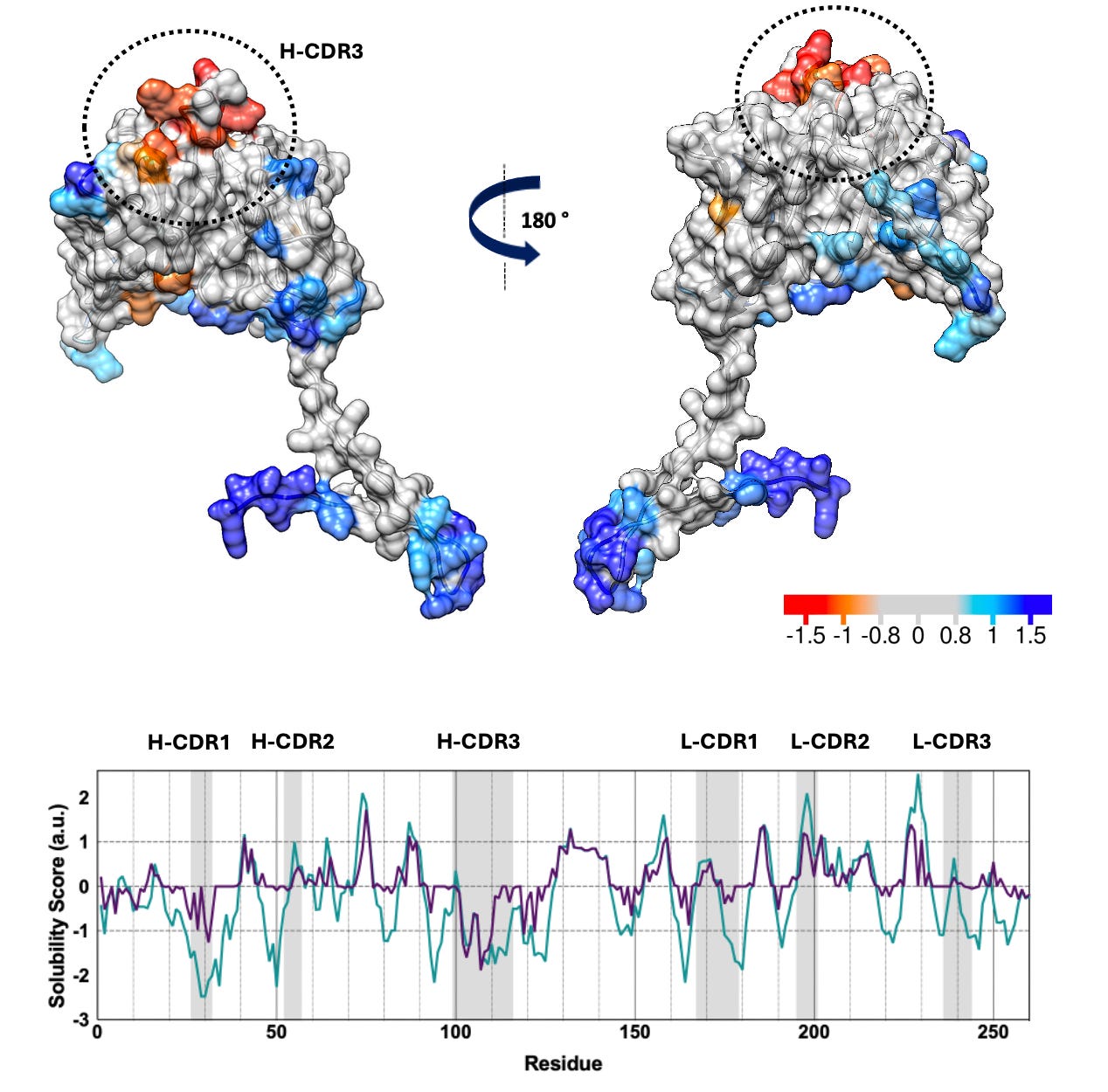
CamSol is a sequence-based method for predicting protein solubility and generic aggregation propensity, developed by Dr. Pietro Sormanni in the lab of Professor Michele Vendruscolo at the University of Cambridge (my alma mater, which makes it even cooler). Using CamSol, one can predict protein solubility as a function of pH and in the presence of post-translationally modified and/or non-canonical amino acids. And beyond sequence-based predictions, CamSol also defines a solubility profile based on structure, taking into account the proximity of amino acids and their solvent exposure. How cool is that?
Mapping the solubility profile of every individual amino acid based on both its intrinsic solubility and its positioning in the 3D structure, allows us to assess the impact of aggregation on binding properties. This is an example of an scFv (single chain variable fragment antibody) I was working on during my PhD. Excellent binding profile, with Kd values in the lower nM range. However, the CDR3 regions of the heavy chain (the most important region for binding) had a low solubility profile. Having this knowledge helped me make better decisions about which antibodies to take forward for testing.
I had the chance to work briefly in Dr. Pietro's lab during my PhD, learning from peers who were equally passionate about antibody research. That experience gave me a deep appreciation for how tools like CamSol can bridge rigorous biophysics with practical protein engineering decisions. Check out these papers, Sormanni et al., 2015 and Sormanni et al., 2017 to know more about CamSol.
6. Antibody Term of the Week
Today we’re diving into the most swapped-out words in immunology.
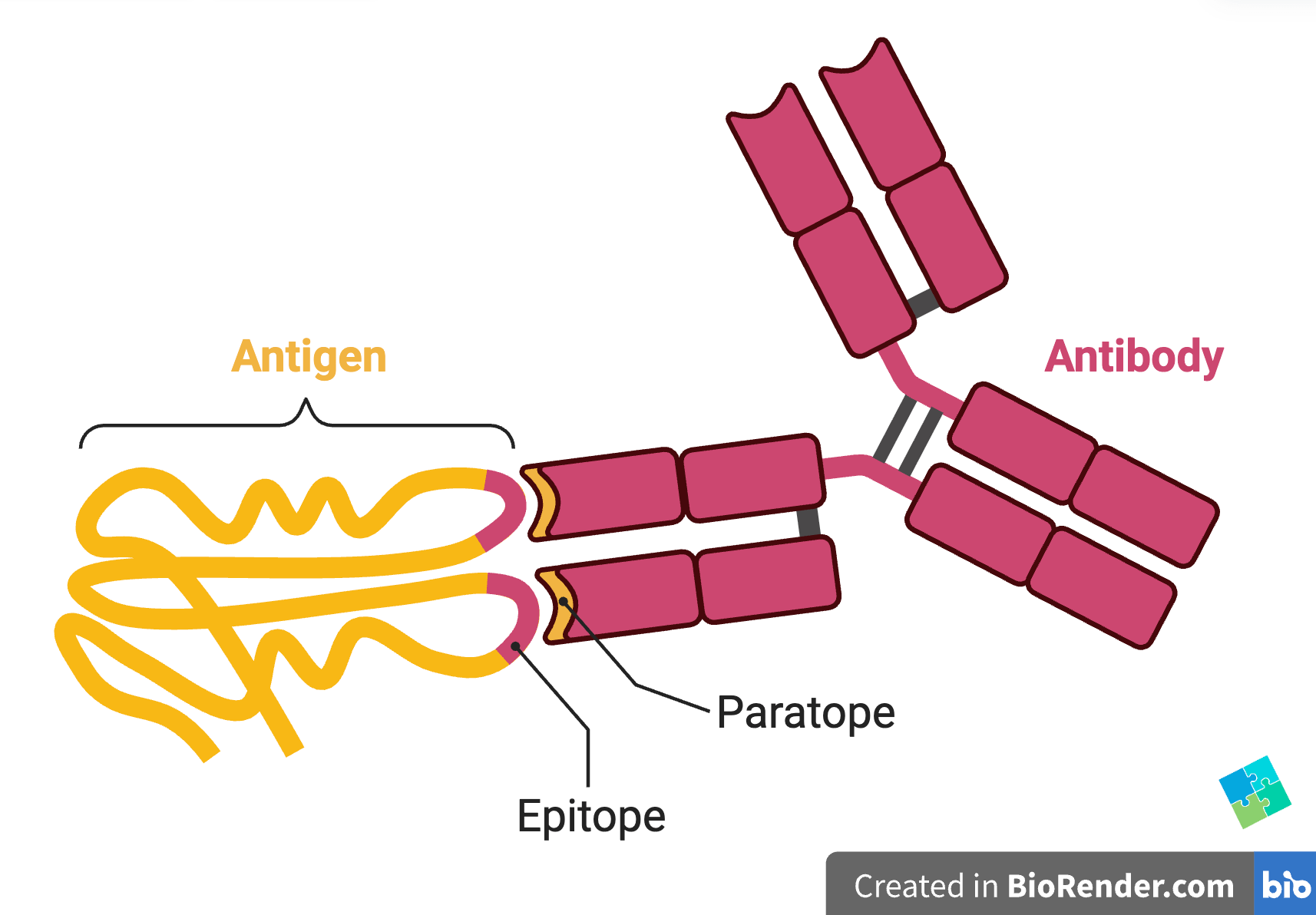
Epitope: Breaking this down to its Greek roots - epi means “on top of” and topos means “place.” So, quite literally, it translates to “a place on top”. This is the site on the antigen where an antibody binds.
Paratope: In Greek, para means “beside” or “alongside”. So, the paratope is the complementary site on the antibody that does the binding, the place that fits alongside the epitope.
Now you might ask: couldn’t epi just as easily refer to something on top of an antibody? Fair enough. But think about who came first. Without an antigen, your immune system would have nothing to respond to, and your B cells would never produce an antibody in the first place. The antigen is the original, the target, and the reason the whole response kicks off. So in keeping with seniority, the antigen earned the epi tag. Snooze, you lose! Thus, the antibody got the para tag, always defined in relation to something else. Hope this helps.
I hope you all enjoyed this edition of ‘The Binding Brief’. If you have suggestions for topics you’d like to know more about… ⤵️
This site is free and I intend to keep it that way for as long as I can because good science communication should be accessible, especially for students. If you enjoy what you read and feel like buying me a coffee along the way, I won't say no. ☕ And if you're not a student, consider paying it forward to one who is.
Your point that fabricated validation data is a problem even if the antibody happens to work is the one I wish more people sat with. Researchers lean on those vendor blots precisely because they don't have time to re-validate everything themselves, so the trust is the whole product. And as the paper you linked shows, plenty of antibodies quietly underperform even without anyone faking anything, which makes this sting more. Glad someone is following it closely. The WB heartbreak line got me too.
That line about western blot heartbreak stroke a chord 💔 Those are truly painful when they don't work as intended. Whenever I see anyone presenting a western data, I always love to comment, "that was beautifully done" before I ask a question. It's like a if-you-know-you-know moment