
V(D)J Recombination and Antibody Diversity Part 1
(I had to coax Nobel Laureate Susumu Tonegawa to write this piece for me).

Disclaimer: This is a fictional piece written from the perspective of Professor Susumu Tonegawa. Much of the content and facts are drawn from his Nobel Prize lecture and interviews online. I've taken the liberty of adding some fictional elements for the sake of storytelling. These will be obvious as you read along. Over to Prof. Susumu Tonegawa.
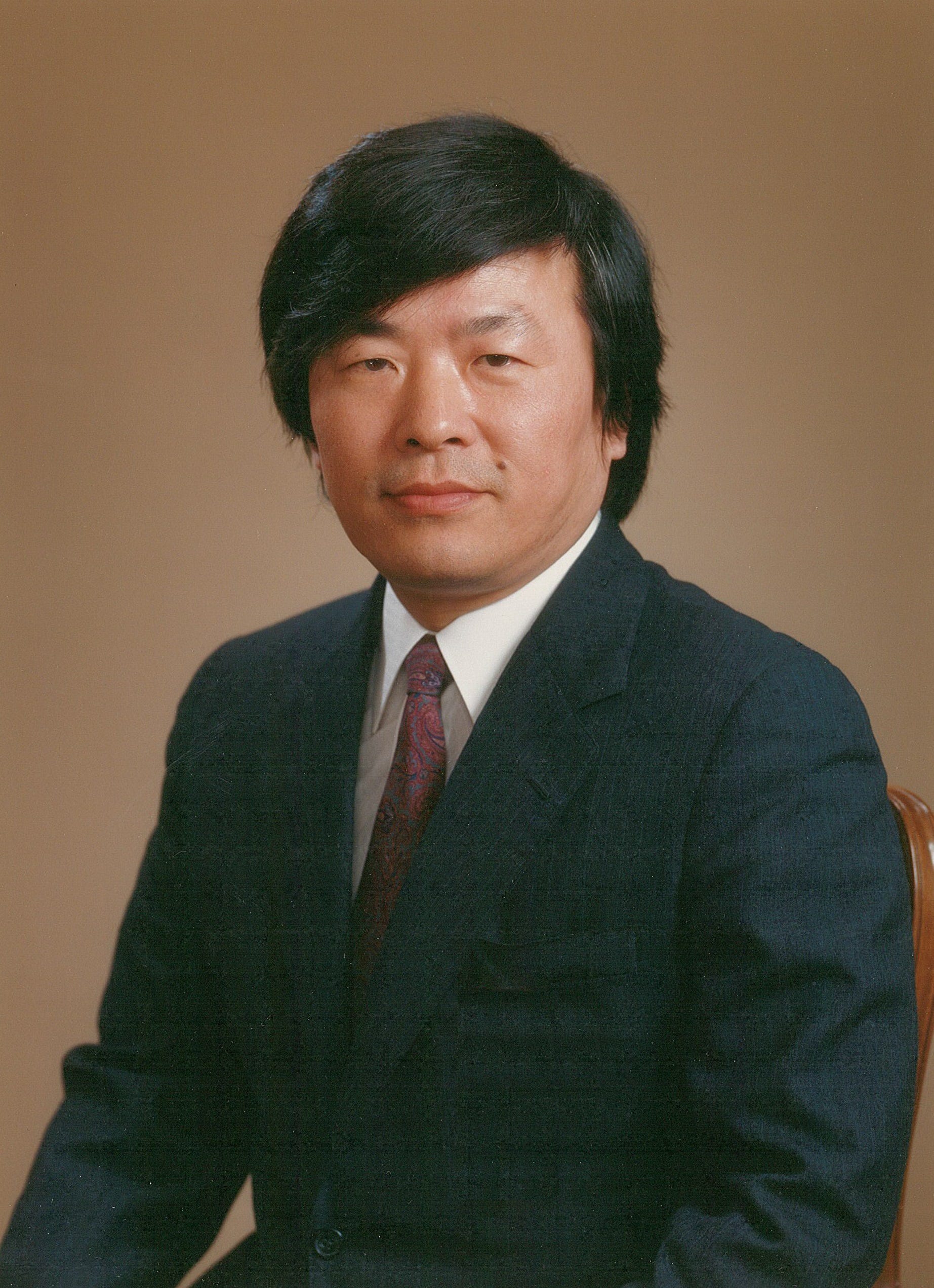
Today is Wednesday, July 1, 2026. I am sitting in my lab at Massachusetts Institute of Technology (MIT) in Cambridge, USA. Through my window, the Charles River sits flat and still. The MIT corridors behind me, the interconnected buildings running across the length of campus, all empty. All students are on summer break with their families, barring a few graduate students that have stayed back to attend to their lab experiments. Fall is getting ready to start - a beautiful season of different hues of colored leaves. I sit with my paper and pen at my desk. Dr. Madhuri Manohar, who runs a remarkable antibody publication called The Binding Site, has asked me to go down memory lane and write about my days as a scientist. My mind goes back, immediately, to the fall of 1970.

The Pivotal Letter, Fall 1970
I was a postdoctoral fellow at the Salk Institute in San Diego in the laboratory of Renato Dulbecco, studying Simian Virus 40's gene transcription control, content in my molecular biology exploration. Prof. Dulbecco was on vacation in Europe when he penned a letter that changed the trajectory of my life as a scientist.
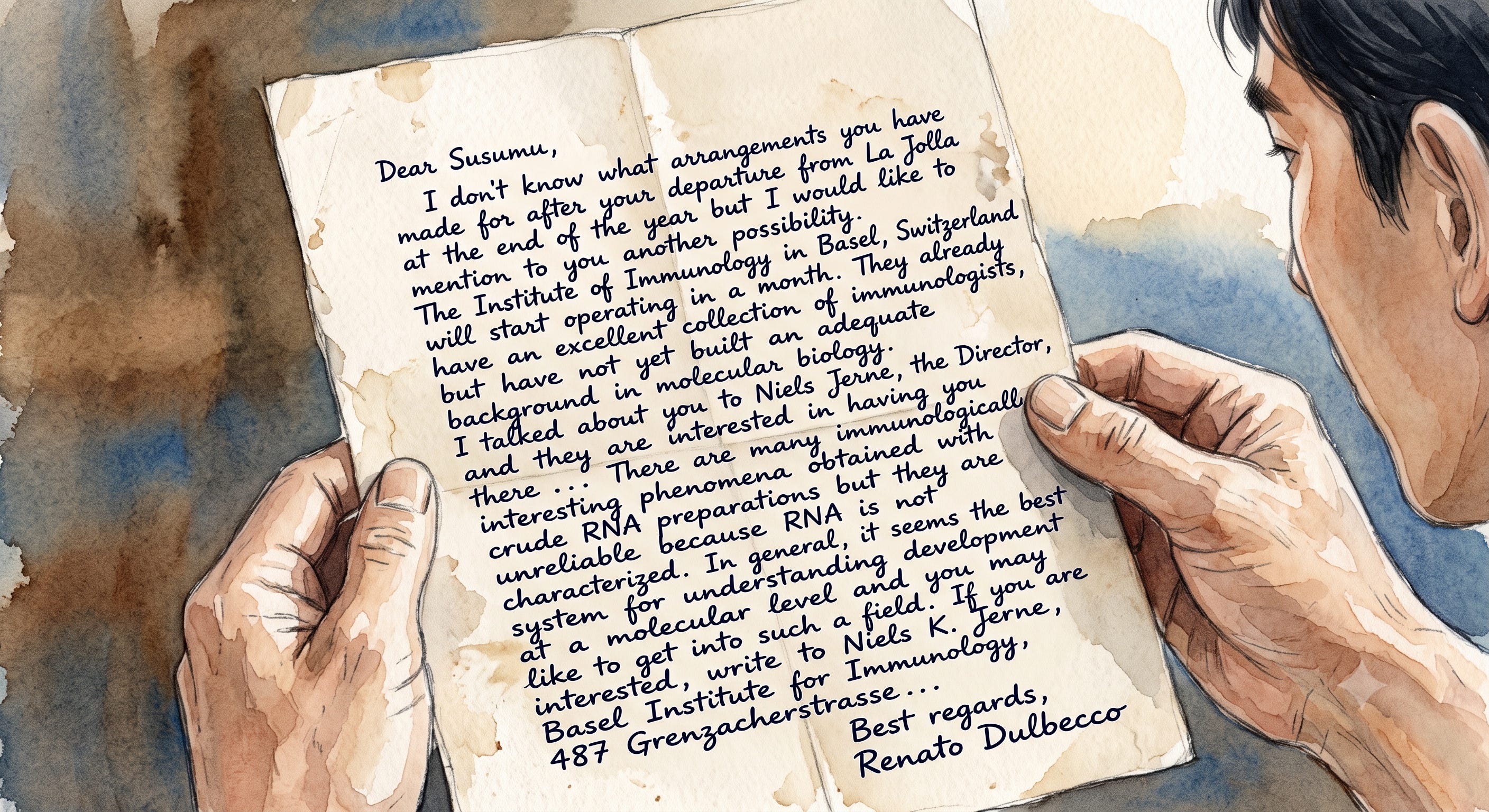
I didn’t know what lay ahead for my future. But, with encouragement from Dulbecco and my impending visa expiration in the USA, I found myself packing my bags and moving across the pond to the Basel Institute for Immunology in Switzerland in February 1971. It was time for new beginnings.
Not only did I move from La Jolla to Basel, but I had to switch majors from molecular biology to immunology. It was a drastic change and the first 12 months weren't easy for me, with limited formal training in immunology. I was surrounded by immunologists. I credit Ita Askonas and Charlie Steinberg as my immunology tutors and I learnt much, by talking to them, asking questions without hesitation, and reading a lot of papers. Back in the day, we didn't have antibody-based blogs like this one. So journal articles were my only recourse.
I was wondering what to focus my research on when I was introduced to the problem of the origin of antibody diversity.
The Genomic Math Problem
When I arrived in Basel in 1971, Edelman and Porter had elucidated the the beautiful structure of an antibody through 1950s and 1960s. In fact, they were getting ready to receive the rewards for their hard work - the 1972 Nobel Prize in Physiology or Medicine. Indeed, it is a well-deserved award that paved the way for immunologists to dig deeper into this fascinating molecule. Madhuri calls an antibody the showstopper of the ‘Paris Fashion Week’ for its elegant structure and I concur. Even today in 2026, all the buzz is about antibody-development that works on modifying this structure, but keeping its essence.
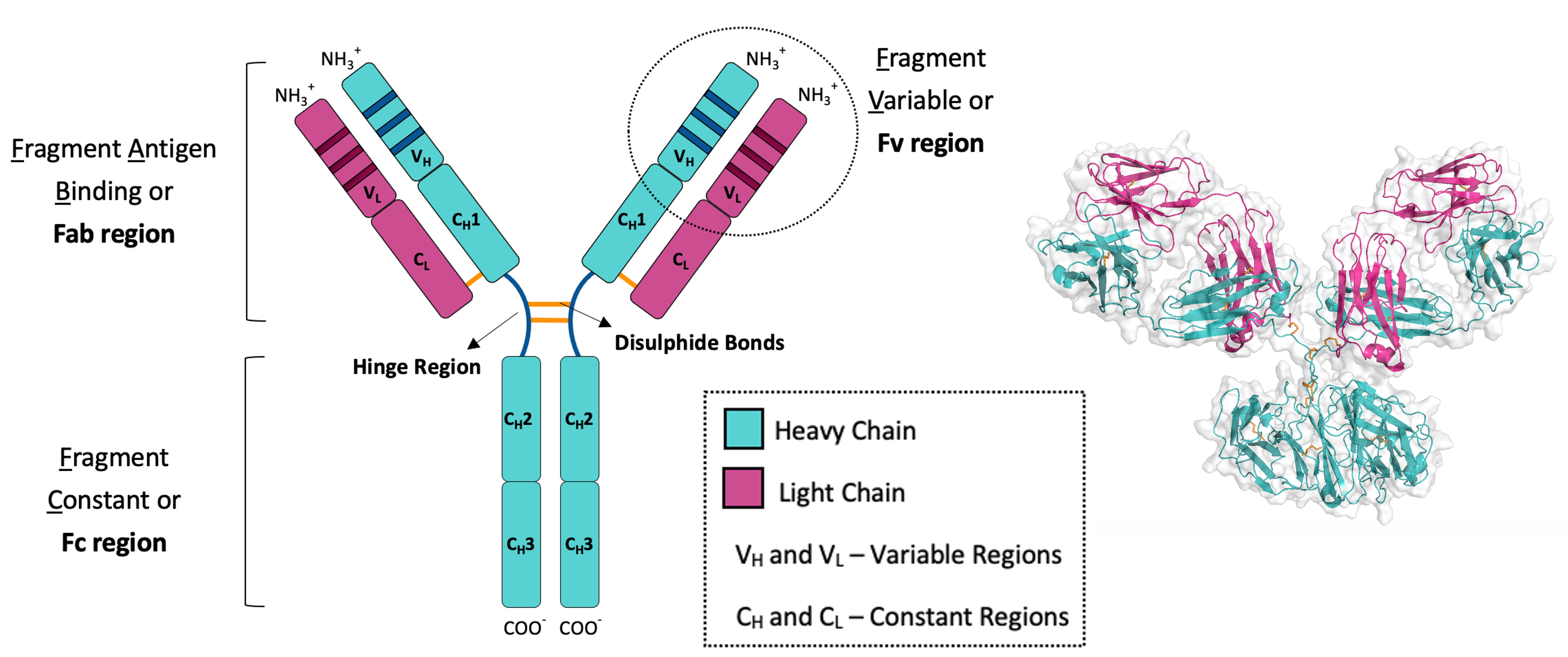
The structure of an antibody has 2 heavy chains and 2 light chains, with variable and constant regions, to make this iconic Y-shaped configuration. Each of these heavy and light chains have one variable Fv region containing 3 nuanced regions called complementarity-determining regions (CDRs). These CDRs provide maximum diversity, allowing our bodies to recognize, bind, and neutralize countless pathogens.
But something didn’t quite make sense. Man is surrounded by an enormous number of viruses, bacteria, and other microorganisms. Some new viruses haven’t even come into the picture. At that time, none of us could predict we’d have COVID-19 coming up in about 5 decades. But, our immune system, specifically B lymphocytes, is somehow able to hand out antibodies that can identify all these new pathogens around. How is that possible? How does the lymphocyte know to make all these several different kinds of antibodies? More over, we have only about 20,000-25,000 genes (as we know today from the Human Genome Project, completed in 2003). Mathematically, how are these few genes going to make antibodies unique enough to attack several unique micro-organisms, MILLIONS in number, that too BEFORE it even encounters an antigen. The math and chronology quite doesn’t add up.
At that time, there were 2 schools of thought on how the diverse set of antibodies came into existence. Screen-printed custom-made T-shirts had just become a cultural fashion thing in the US and we even made special ones for the two teams of immunologists - one for the Germline Guardians and one for the Somatic Shufflers.
The Germline Guardians believed that the antibody diversity was inherited from their parents through germline cells. Every unique antibody came from an immunoglobulin gene from either parents, and that gene was translated into a protein. No gene-processing mechanisms.
The Somatic Shufflers, on the other hand, believed that there is only a limited number of antibody genes and there has to be some sort of process that resulted in diversification with the genes in B lymphocytes. No generational genes passed along in the will.
I was in team Somatic Shufflers (I still have my T-shirt even today), and while there was no standardized techniques such as the Southern Blot available back then for analysis, the math discrepancy in the germline theory had me lean more towards the somatic gene-processing theory. There had to be some sort of rearrangement happening that accounted for this enormous antibody diversity.
“Every Day I’m Shufflin”: Solving the Chronology Problem
Looking back from 2026, I find it hilarious that LMFAO’s Party Rock Anthem didn’t come out until 2011. Because as early as 1976, I had figured out that every day we are indeed shuffling and this is what creates the diversity in antibodies that protects us against all sorts of pathogens. An elegant process called Variable-(Diversity)-Joining Recombination or V(D)J Recombination is responsible for this shuffling. It is so named because this diversity comes from the different gene segments present on the chromosomes in the germline DNA - V, D, J, and C segments.
Recapping the ‘Central Dogma of Molecular Biology’ before we go ahead. This dogma describes the one-way flow of biological information: DNA is transcribed into RNA, and RNA is translated into protein. The instructions are written in DNA, copied into RNA as a working transcript, and finally read out as protein. Proteins are the molecules that actually do the work.
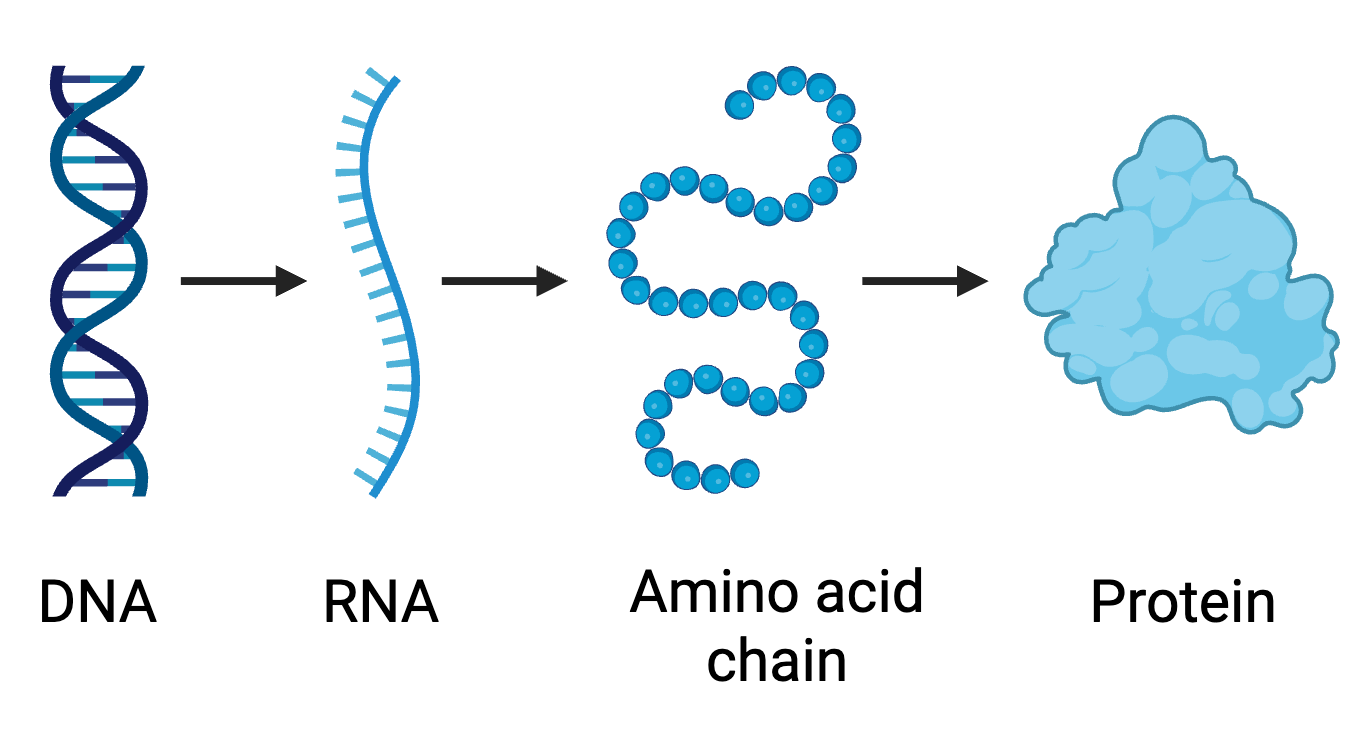
Each of these has several steps. The one relevant to our discussion now is splicing. The RNA initially is a pre-mRNA that matures into mRNA (mature RNA) by removing all the junk in between. The mRNA is translated into a long stretch of amino acids which when folded becomes the functional protein. I hope this helps for the discussion ahead!
So, how do these V, D, J, and C segments come together to make up the heavy and light chains of the antibody?
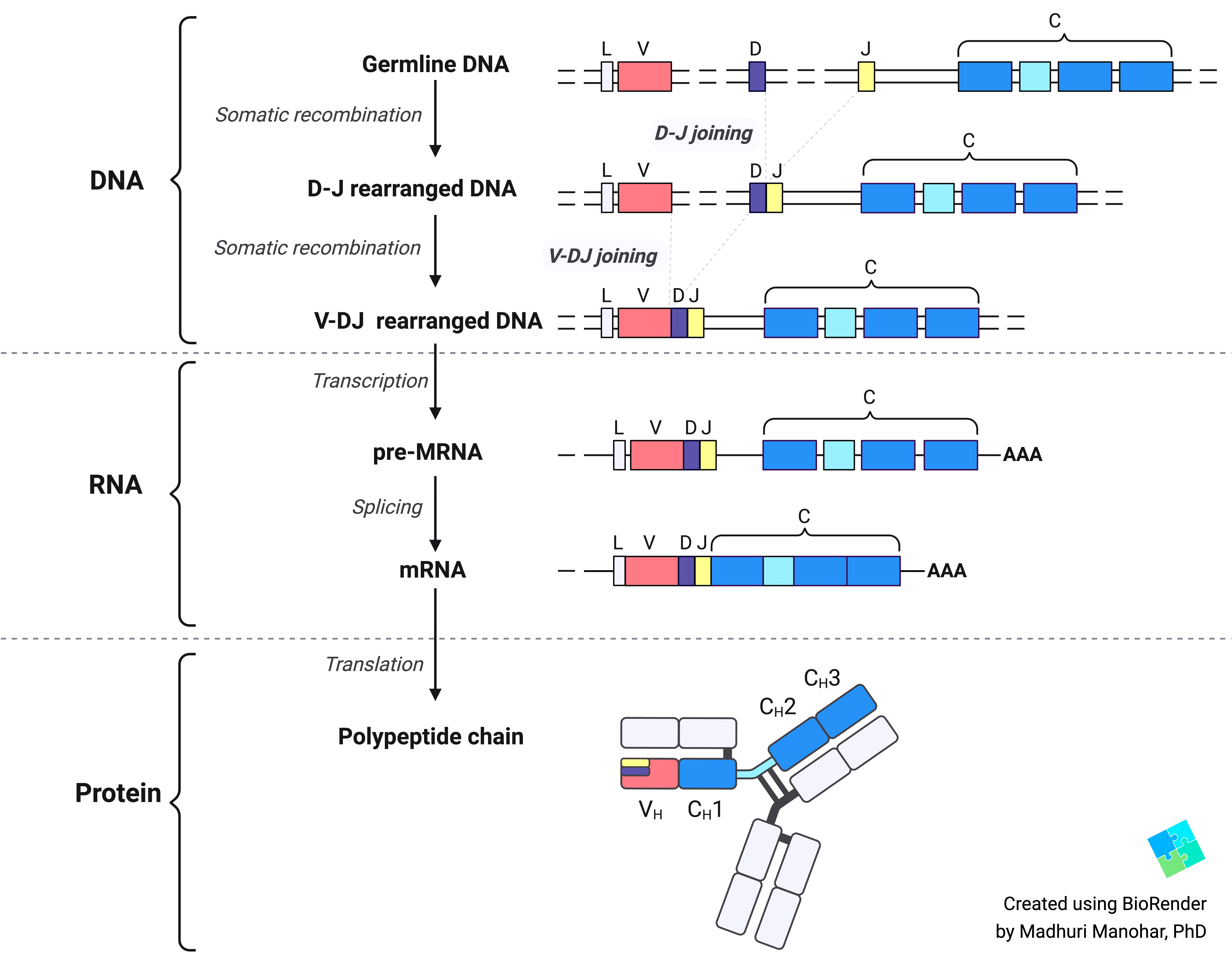
Let’s start with the heavy chain. The heavy chain’s gene loci are present on chromosome 14. The V-D-J-C segments are well-separated with non-coding regions in between, and through the process of somatic recombination, they are brought together. Think of it like an arts and crafts project! The immunological scissors haven’t been discovered yet, at this point in history (You’ve to wait until 1989/1990 for that). But, I know that there is some kind of scissors that is doing the cutting (Madhuri will tell you more about it in Part 2 of this article).
First, the scissor cuts and joins the D and J gene segments to form the DJ segment. Then, the V segment is combined with DJ segment to form the VDJ segment. This VDJ recombination occurs at a DNA level, with the C segment still sitting afar in the chromosome, separated by introns (non-coding DNA). Then, this long stretch of DNA is transcribed into a long pre-mRNA. Through splicing, the intronic sequences are removed between the VDJ and C, joining them together into one continuous mature mRNA. This mature mRNA is then translated into the heavy chain of the antibody. The VDJ becomes the variable domain of the antibody and the C region forms the constant domain.
Coming to the light chain, they are of two kinds: Kappa and Lambda (we’ll get into that later). Kappa light chains come from chromosome 2 and Lambda from chromosome 22. The exact same process as heavy chains occurs with one slight tweak. The light chain is built from V, J, and C gene segments, and the chromosomes do not have D segments. This makes the process simpler. The V and J segments undergo DNA recombination, and when the pre-mRNA is undergoing splicing, it joins the C to VJ segment forming a VJ-C mature RNA, that is ultimately translated into the light chain of the antibody.
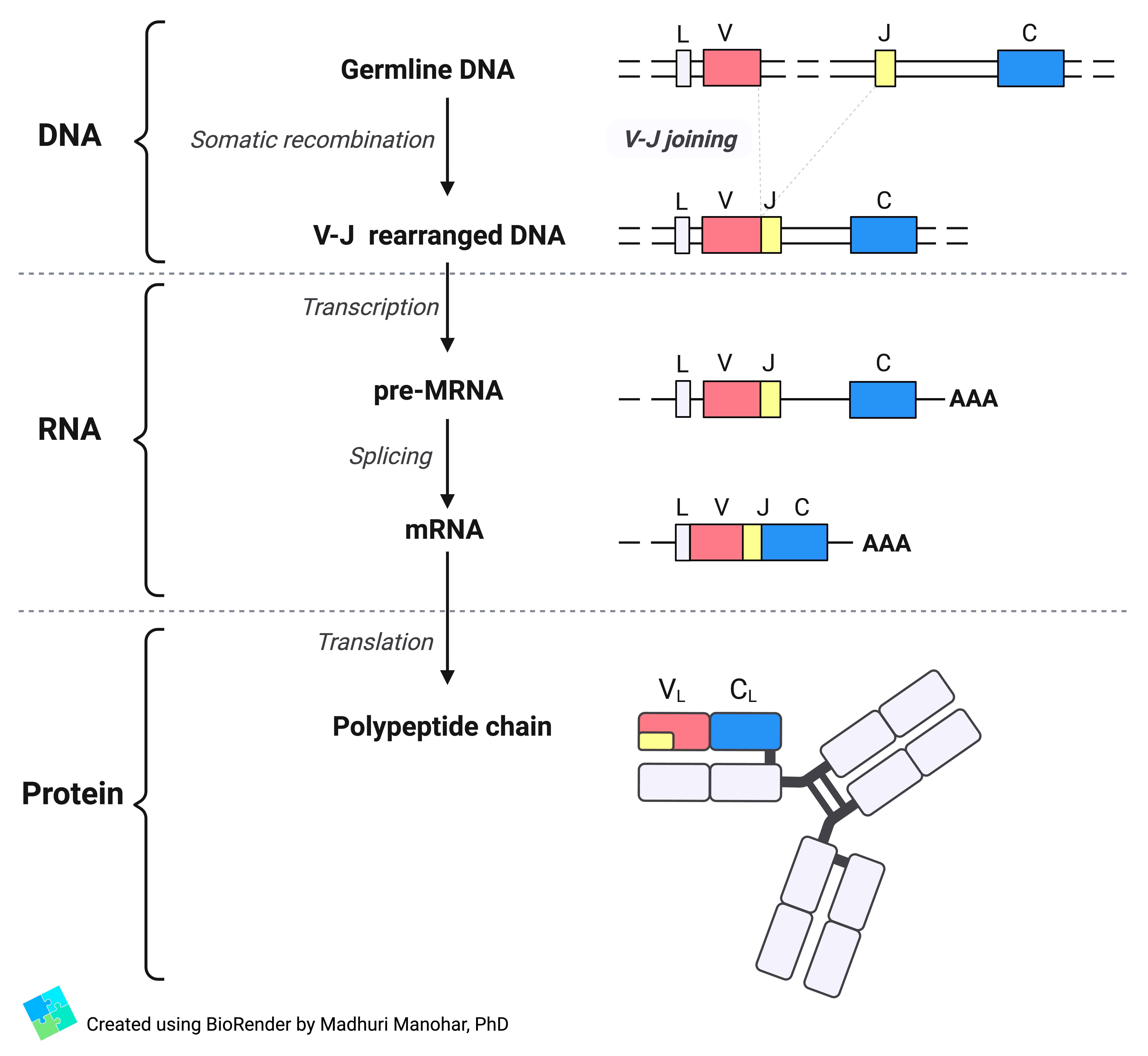
If you notice this elegant process of V(D)J Recombination, I haven’t mentioned anything about the antigen. Essentially, your immune system doesn’t even have to meet the antigen for it to create an antibody, thus solving the chronology problem.
Antibody Fun Fact: I’m sure you’ve caught it by now. The heavy chain of an antibody has a significant more involved role in antibody diversity than the light chain. This key point will come in handy during the antibody engineering.
Solving the Math Problem
While this seems like a super elegant process, you might wonder, how is this still solving the mathematical problem we had. Few thousand genes but several million pathogens! Except that, there isn’t just 1V, 1D, 1J, and 1C in human chromosomes. We have several kinds of each segment and each of these can recombine in any combination to form a sequence that has 1V, 1D (heavy chain only), and 1J each.
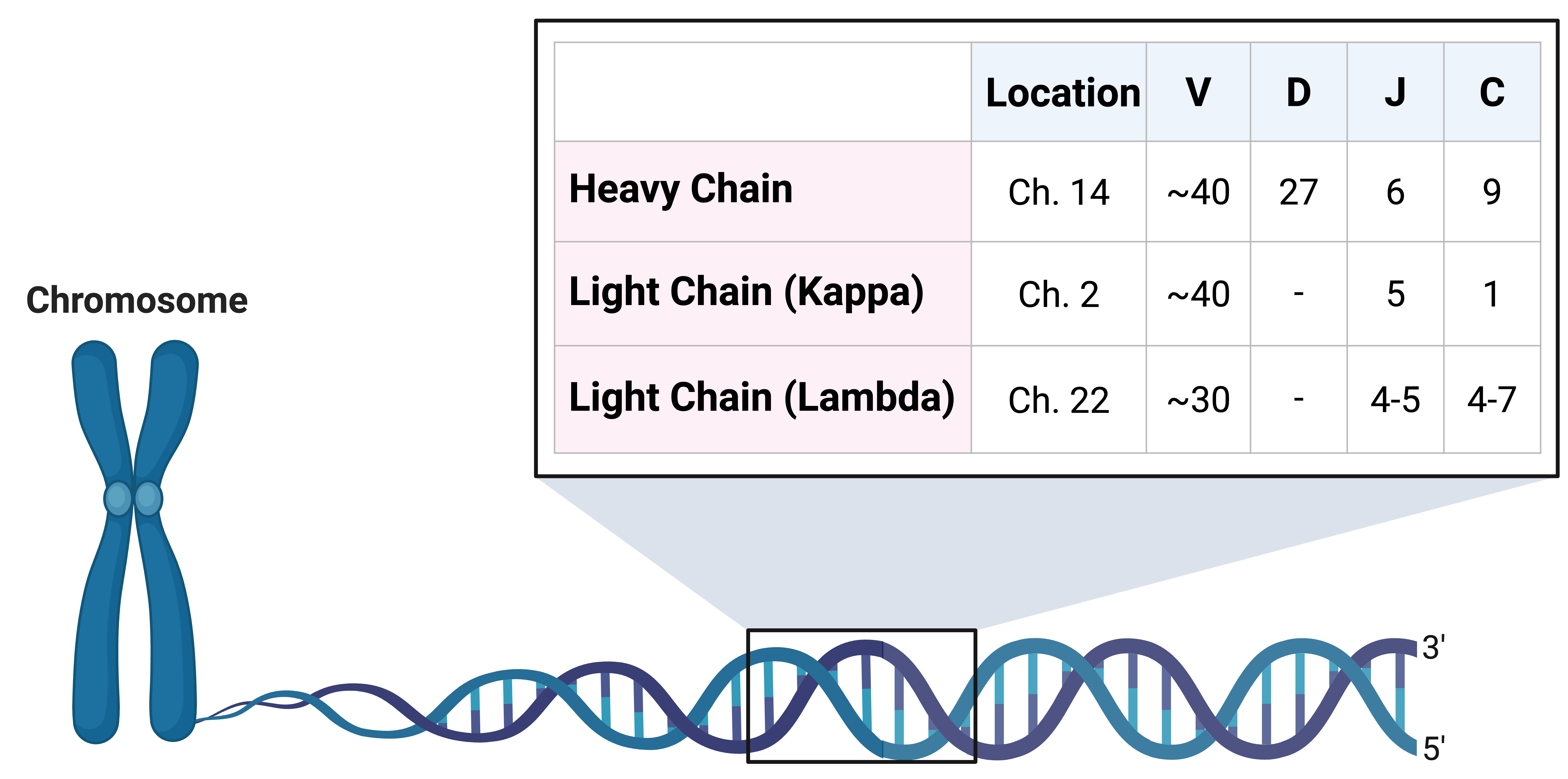
For the heavy chain alone, it will give rise to ~40 x 27 x 6 = ~6480 possible heavy chain combinations. As for the light chain, 60% of B-cells use kappa genes and 40% use lambda genes. Kappa contributes ~40 x 5 = ~200 kappa light combinations and lambda contributes ~30 x 4 = ~120 lambda light combinations. This leads to roughly ~320 light chain combinations. Since an antibody needs one heavy chain and one light, the combined possible diversity is ~6480 x ~320 = ~2.07 million combinations.
This means your body has the capability to target and attack ~2.07 million unique pathogens around you even before it has met them. Mindblowing, isn’t it?
This is only the combinatorial diversity! We have many other contributing factors to add to this diversity and fix the mathematical problem we spoke about earlier. We haven’t even counted the C segments (I knew you were wondering!). At the junctions between segments as well, there is some diversity happening. Your immune system doesn’t wait until it has met the antigen to get ready for attack. All this diversification creates several billion antibodies in advance ready to go to the battlefield. Once it meets the antigen, some refinement in the antibody happens by a process called somatic hypermutation. Think of it as a huddle to revise and update strategies once you encounter your opponent on the field.
In short, I wanted to tell you all that your immune system really goes all out to protect you from pathogens. The next time you feel lonely and think you have no one just for you, remember V(D)J recombination is always there for you!
When I went to Basel as a molecular biologist clueless about immunology, I never realized that my curiosity to solve a simple mathematical problem would one day be of service to the field of Science. I am signing out now. I hope you enjoyed me popping by here upon Madhuri’s request. I know I enjoyed this chat with you all and I hope she invites me back for other articles in the series. Until then, keep the curiosity alive.
This is a fictional piece written from the perspective of Professor Susumu Tonegawa. I hope you enjoyed it! Susumu Tonegawa is a Japanese molecular biologist born in 1939 in Nagoya, Japan. He conducted his landmark research at the Basel Institute for Immunology in Switzerland. For the discovery of this process called V(D)J recombination, he was awarded the Nobel Prize in Physiology or Medicine in 1987. He is currently a professor at MIT, where he leads the Picower Institute for Learning and Memory, having since pivoted his extraordinary scientific mind to the study of neuroscience.
This site is free and I intend to keep it that way for as long as I can because good science communication should be accessible, especially for students. If you enjoy what you read and feel like buying me a coffee along the way, I won't say no. ☕ And if you're not a student, consider paying it forward to one who is.
Interesting story!
I was curious, when we say immunity reduced due to age or other factors, is that related to reduction in the antibody diversity?
Amazing storytelling!!!
First few paragraphs literally gave me visuals of campus and Prof sitting with pen and paper!!!
And then, fascinating world of science and groundbreaking discoveries!!!
Nice work, Madhuri!!!
☺️👏🏼